
Huntsville Previous Residents Sources
One Huntsville address can lead through several Huntsville record types, each with a different time range and a different answer. Start with the current Huntsville parcel card because it supplies a present owner name and a legal description. Then use the Official Records index for Huntsville research to walk deeds backward. Huntsville directories, census schedules, tax material, maps, cemetery records, and local archives provide the household layer. A Huntsville source can create a good lead without resolving the whole story. Mark whether each row describes an owner, a listed occupant, a subscriber, a taxpayer, or a structure.
| Source | Years It Covers | Where Held | What It Shows |
|---|---|---|---|
| Walker deed record microfilm | 1846–1886 | SHSU and TSLAC reels 1034875–1034888 | Grantor, grantee, volumes, pages, and legal instruments; no Volume J |
| Walker Official Records portal | Certified through August 27–28, 2026 when inspected; online start year not posted | Walker County Clerk | Party, recording, instrument, legal-description, and document filters |
| Walker CAD roll | Sample cards showed 2018–2026 | Walker CAD property search | Owner, mailing and situs addresses, values, legal description, and some deed history |
| Walker tax rolls | 1846–1910 | SHSU reels 123601–123604 | Annual tax assessment and taxpayer context |
| Huntsville city directories | 1975 and 1990 named by TSLAC | TSLAC; local holdings need confirmation | Dated listed occupants, address, and possible spouse or occupation |
| Federal census | Released by the 72-year rule; 1790–1940 through HeritageQuest | HPL, Ancestry Library Edition, HeritageQuest, and NARA | Household names, ages, relationships, and address geography |
| Walker scholastic census | 1928–1971 with documented gaps | SHSU reel series 1034898A–W | School-age names and local residence clues |
| Sanborn map item | Exact local years not verified | Library of Congress and Texas historical-map routes | Building footprint, materials, use, and street context |
Recent Huntsville periods usually begin with CAD and the Walker County Clerk portal in Huntsville. Earlier Huntsville periods usually require the Huntsville counter, a record request, microfilm, library equipment, or an archive contact.
Huntsville Parcel Records for Past Residents
The Walker CAD property search is the first official Huntsville address-to-owner lead when the parcel is taxable. Its public form supports owner name, street number and name, property ID, owner ID, geographic ID, abstract, subdivision, neighborhood, and other fields. If a full Huntsville address fails, CAD guidance supports trying the street name alone. Save the property ID, geographic ID, exact Huntsville situs address, owner name, mailing address, abstract or subdivision, lot and block, and any older roll years. Those details make the next Huntsville Clerk search much less fragile.
A Huntsville CAD card is not a household census. The situs address is the Huntsville property address, while the tax mailing address can point to an owner, trust, agent, or prior address elsewhere. The card may show values, taxing entities, roll history, and sometimes deed history, but it does not name every occupant. Some exemption information is also withheld online for privacy. Keep the mailing address separate from the property address and use the legal description to distinguish same-name owners.
Note: Treat the Huntsville CAD result as the current parcel anchor, then use the historic sources to test every earlier owner or household claim.
Huntsville Deed Index Fields
The Walker County Official Records advanced search supplies the Huntsville bridge from a parcel to recorded instruments. It separates party, grantor, and grantee fields and accepts recorded or instrument dates, document numbers, book, volume, page, lot and block, legal-description terms, document type, and image phrase controls. A simple Huntsville address rarely solves the full chain. Translate the Huntsville situs address into the subdivision, lot and block, abstract, or other legal wording on the CAD card. Then search the current owner as grantee and inspect the resulting instrument.
The quick search for Huntsville research also accepts grantor or grantee, subdivision, document type, document number, date range, and index or OCR modes. If the portal result stops short of an older deed, the Walker County Clerk in Huntsville holds real-property records and provides a counter and request route. Ask for the Huntsville counter index, older deed book, microfilm, or a certified copy when needed. The current portal’s certified-through notice does not publish its historical online start date, so it should not be treated as proof of a complete digitized chain.
Huntsville Previous Residents Deeds
A Huntsville chain of title is a sequence of recorded transfers, not a list of every household. Begin with today’s Huntsville CAD owner and search that name as a grantee in the Clerk index. The deed generally identifies a seller, known as the grantor, and an instrument date, recording date, document number, or book and page. Search that seller as a grantee in an earlier window to find the prior acquisition. Repeat the Huntsville sequence. If an estate, trust, corporation, spouse, or “et al.” appears, search that name separately and look for probate, heirship, release, plat, assumed-name, or vendor’s-lien records.
- Save the current CAD card and copy the legal description exactly.
- Search the current owner as grantee, then record the seller, date, instrument type, and document reference.
- Search that seller as grantee in an earlier date range and add the next deed row.
- Check a trust, estate, corporation, or abbreviated party name as its own record trail.
- When the online trail ends, request the Clerk index, deed book, microfilm, or certified copy for the older link.
- Grantor
- The party transferring an interest in a recorded instrument, often the seller in a deed.
- Grantee
- The party receiving an interest. Searching a prior grantor as grantee is the backward move.
- Chain of title
- The dated sequence of recorded land transfers used to trace ownership.
- Legal description
- The subdivision, lot, block, abstract, acreage, or similar land identifier. It can remain useful when a street form changes.
Huntsville Microfilm Volume Gap
Walker County’s older deed records used in Huntsville research do not begin with an online search box. The state microfilm guide documents Walker County deed records from 1846 to 1886 on reels 1034875 through 1034888. It also makes an unusually useful archival point: there was no Volume J in the Deed Record. Seeing volumes A through I followed by K is not proof of a missing person, a lost Huntsville parcel, or a scanning error. Record the reel, volume, page, and legal description as written before deciding a transfer cannot be found.
The Texas State Library Walker County microfilm guide documents the deed and related county-record runs.
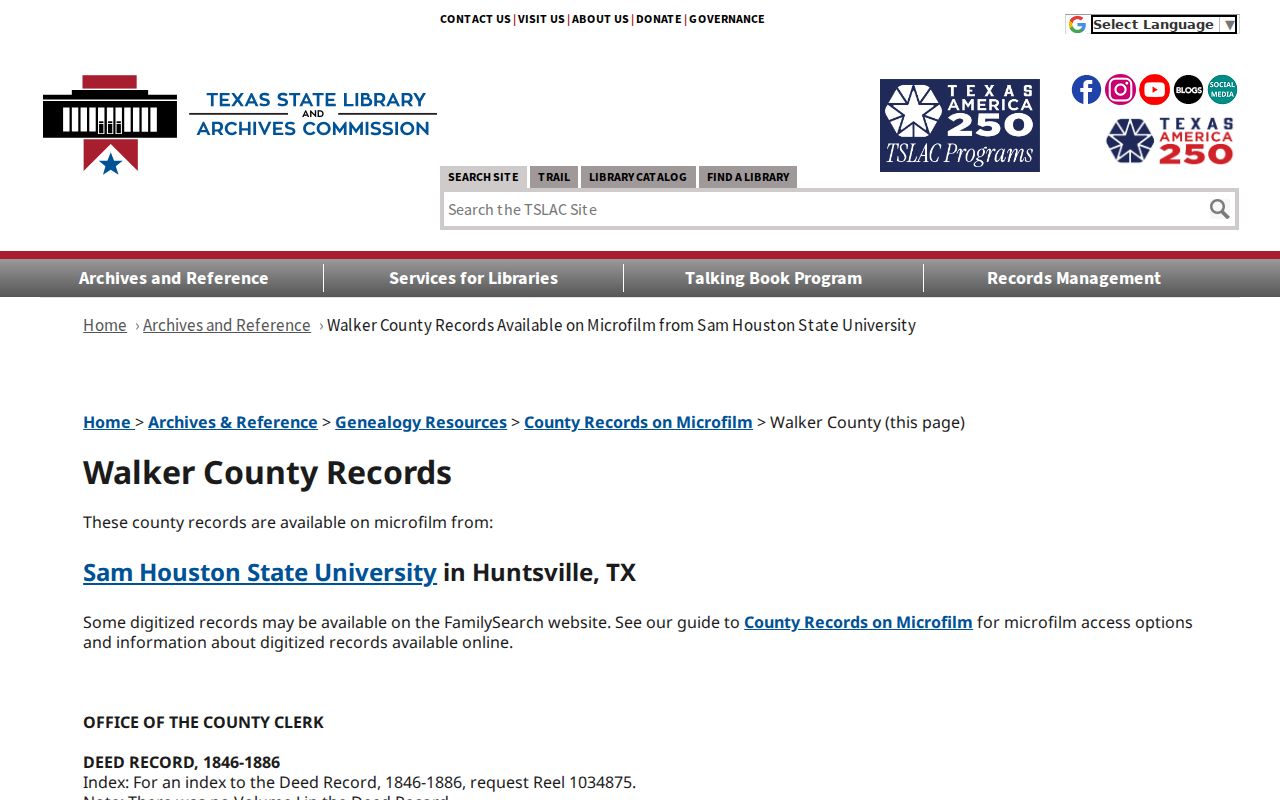
The same guide reaches back to Walker County marriage, probate, district-court, naturalization, tax-roll, and scholastic-census material, allowing a Huntsville household question to continue after a deed search becomes thin.
Walker County tax rolls used in Huntsville research extend from 1846 to 1910 and can place a taxpayer in a year without proving that person lived at the address. Delinquent tax record runs from 1919 to 1978 are also listed in physical holdings, with varying gaps and arrangements. Use them as annual Huntsville context alongside, not in place of, the deed record.
Huntsville Past Residents Snapshots
Huntsville past residents need a second trail beside the deed chain. The title record answers who received an interest in land. A city or reverse directory can instead show a listed occupant or telephone subscriber at a Huntsville address in a dated edition. TSLAC specifically names Huntsville directory entries for 1975 and 1990, but the research did not confirm a continuous run, publisher, or any local reverse-directory years. That Huntsville gap matters. A person missing from one known edition may have moved, used a different name, lacked a listed telephone, or simply been omitted.
The Texas city-directory research guide explains the on-site directory collection and the wider catalog routes.
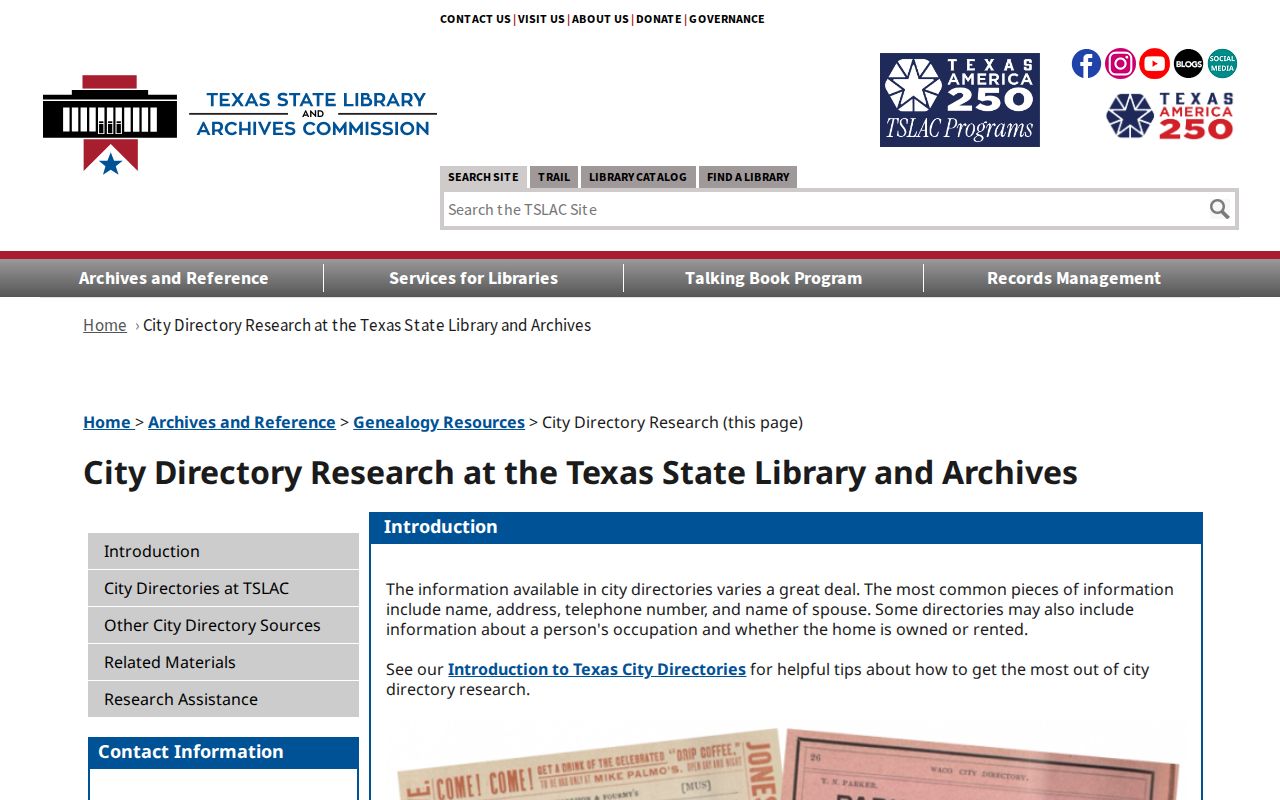
For the confirmed Huntsville books, copy the name, spouse, occupation, address, telephone, and any notation exactly, then label the Huntsville result as a listing rather than ownership proof.
Huntsville Public Library’s Genealogy Room is the practical local fallback for Huntsville volume checks, newspaper microfilm, vertical files, and archive equipment. The directory collections themselves are described in the Huntsville city directory holdings, while this Huntsville address trail uses them as dated household evidence.
Huntsville Previous Residents Census
Pair a verified Huntsville directory year with the census release closest to it, then compare the Huntsville household against the title row. Federal census schedules are released under the 72-year rule. HeritageQuest at the Huntsville library provides federal census images and indexes from 1790 through 1940, and the 1950 census is public. Walker County scholastic census material, dated 1928 to 1971, can supply Huntsville school-age and residence clues. Its missing years are part of the evidence: 1959–60 is I–Z only, 1960–61 is absent, and 1961–62 is A–M and O white only.
- Make one title row for each deed and a separate household row for every directory or census result.
- Match exact address forms, names, initials, spouses, ages, and relationships before merging two rows.
- Use released census material to test the household around a verified directory snapshot.
- Check obituary notices, probate heirs, cemetery records, and permits when a name disappears or a property changes.
- Mark an uncertain identity as unresolved rather than converting a matching surname into a conclusion.
The SHSU Walker County Cultural Resources Collection is one local archive route for historical context, alongside the library, Society, and historical commission.
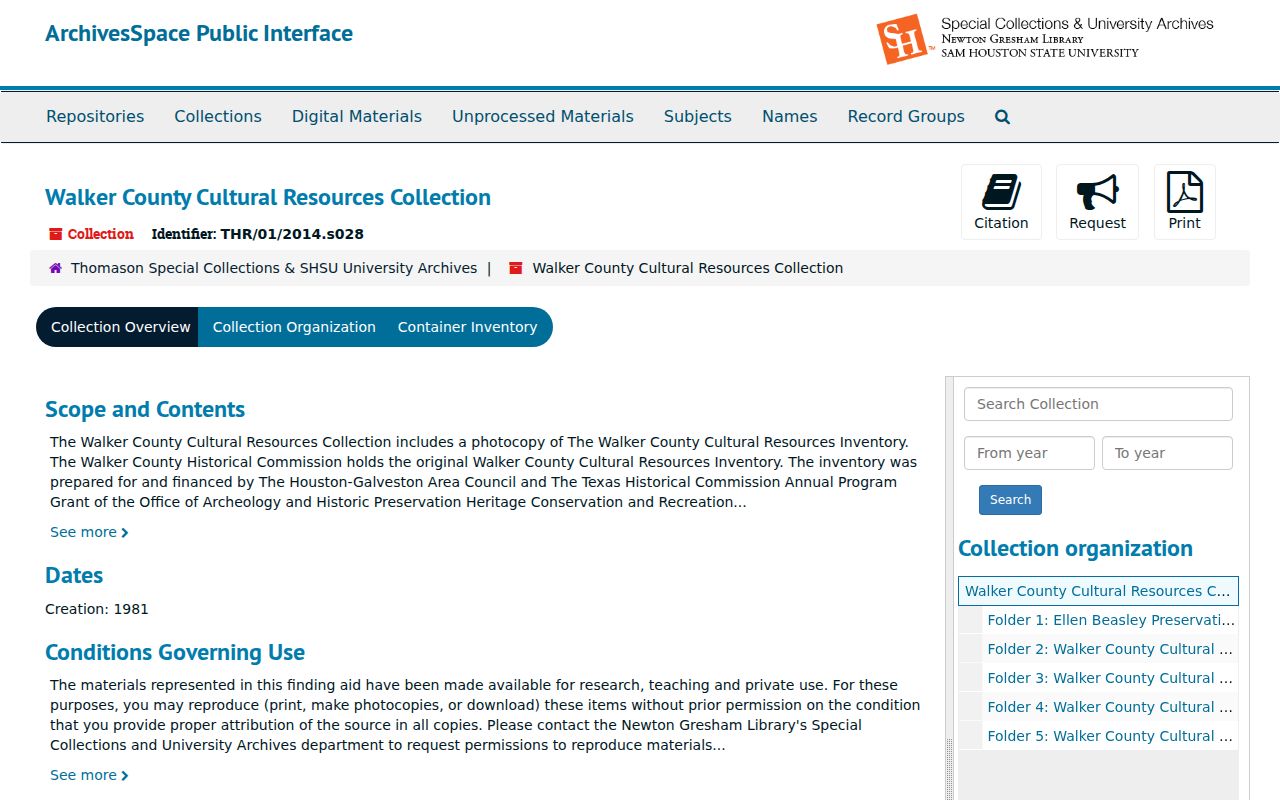
Huntsville archive finding aids can reveal newspapers, maps, family notes, and collection contacts that help test an address spelling or a family connection.
Huntsville Address Trail Limits
Huntsville address continuity is the main trap in house history. Walker County’s 911 address form relies on road side, distance, nearest posted addresses, geographic ID, GPS, and land description. Huntsville street names, route numbers, postal city labels, and municipal boundaries can shift. Search current and older forms, but anchor the Huntsville result to an abstract, subdivision, lot and block, deed book and page, parcel ID, or geographic ID whenever possible. A Huntsville Sanborn map item can show a building footprint, material symbols, use, outbuildings, and street context, but the captured item did not verify every local map year.
Huntsville Development Services has no public permit or code index identified in the research. For dated Huntsville address evidence, request a Huntsville permit or code record by address and date through the department or the city’s Texas Public Information Act channels. Ask for the permit number, description, applicant or owner, issue or final dates, and inspection status. A Huntsville permit can date work at a property. It does not prove a sale or every person who lived there.
Lawful use. Huntsville previous-resident research is suited to family history, estate questions, and house history. Do not use record leads to harass, stalk, or harm anyone; Texas law prohibits those acts.
Note: Keep an unresolved Huntsville gap open when records change names or address forms, because a blank search result is not proof that a property had no owner.